 Türkçe
 English
 Français
 Русский
 中文 (中国)

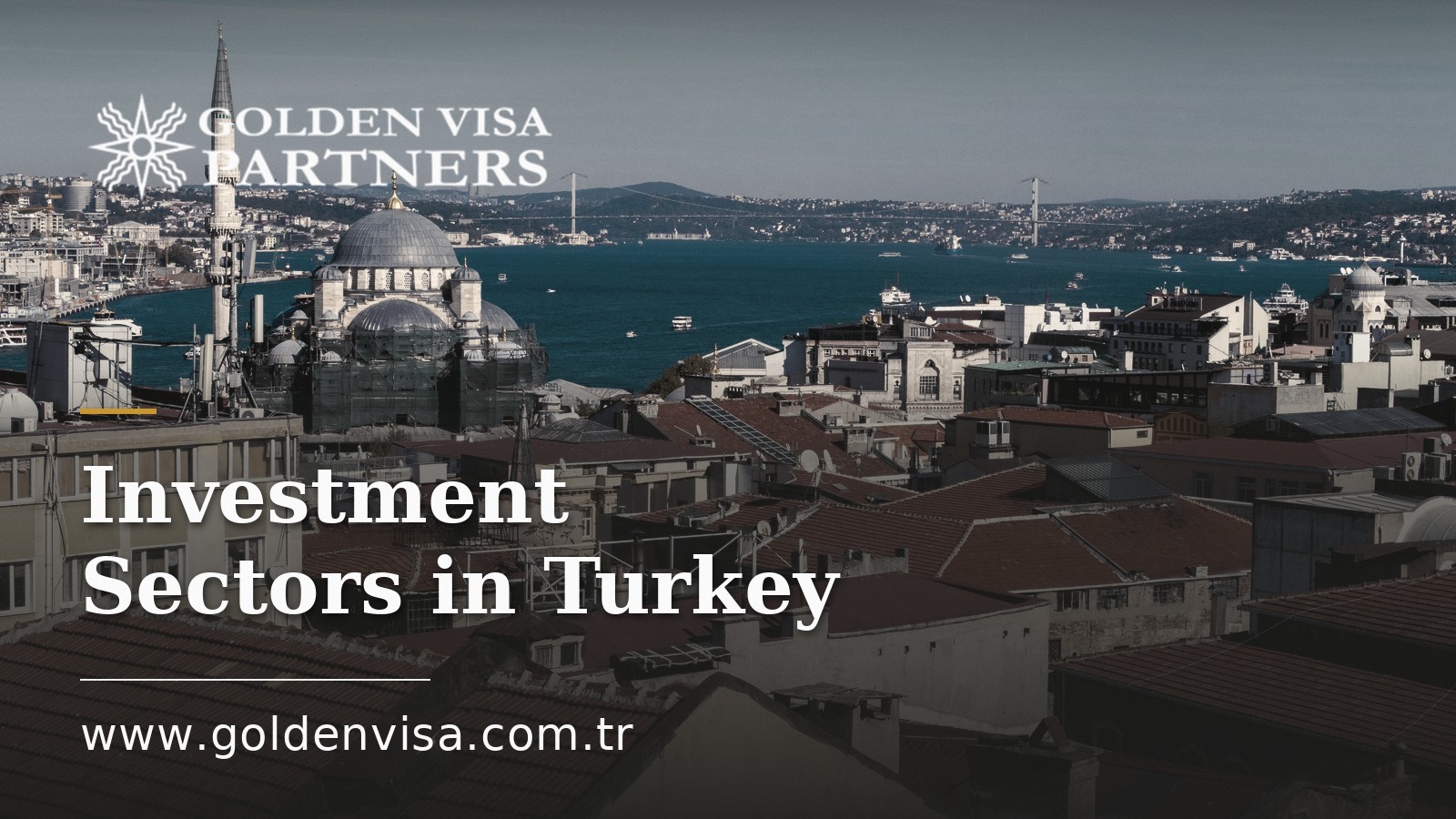
The strongest investment sectors in Turkey heading into 2026 are real estate, renewable energy, technology and software, manufacturing (especially automotive and defense), and tourism. Each is supported by solid domestic demand and by targeted government incentives. This guide sets out, sector by sector, why it is growing, the typical way to get in, the incentive framework around it, and the risks worth weighing, from an independent advisor's view rather than a sales pitch.
At Golden Visa Partners we have guided more than 2,000 investors from over 40 countries through citizenship, residence and real estate processes in Turkey since 2018. The assessment below is built from what we see happen on the ground, not from marketing claims.
Why does Turkey attract foreign investors?
Turkey sits at the crossroads of European, Middle Eastern and Asian trade routes, has a large young population, and carries a broad manufacturing base, a combination that keeps it attractive to foreign capital. Thanks to the Customs Union, a wide range of industrial goods made in Turkey reach the European Union market tariff-free.
The picture is not one-sided, though. Lira volatility, inflation and shifting regulation all feed directly into the return calculation. That makes timing your entry and managing currency risk just as important as picking the right sector. For official investment data and the current incentive lists, the Presidency of Turkey's Investment Office publishes an investment incentives page that is the reference source.
Investment sectors in Turkey: a quick comparison
The table below summarizes the five leading sectors, their typical entry route and their main risk. Figures are approximate as of early 2026 and should be confirmed before you act.
| Sector | Standout opportunity | Typical entry route | Main risk |
|---|---|---|---|
| Real estate | Residential, commercial and logistics assets; citizenship eligibility | Direct property purchase or project partnership | Price volatility, currency risk, valuation gaps |
| Renewable energy | Growth in solar and wind capacity | Licensed or unlicensed generation investment | Grid connection and regulatory change |
| Technology and software | Fintech, gaming, e-commerce ecosystem | Company formation or startup partnership | Competition for skilled talent, scaling |
| Manufacturing and automotive | Export-based production, EU market access | Production facility or joint venture | Input costs, supply chain |
| Tourism | Hotels, boutique accommodation, health tourism | Business acquisition or development project | Seasonality, demand swings |
Real estate: the best-known entry point
Real estate investment in Turkey is the most common starting point for foreign investors, offering both rental yield and potential appreciation. Demand for housing is strong in cities such as Istanbul, Izmir and Antalya, while logistics and commercial space is drawing interest as e-commerce grows.
Property is also the most visible route to Turkish citizenship. As of early 2026, foreigners who buy property worth at least USD 400,000 and register a three-year non-sale restriction on the title deed can apply for citizenship by investment once the other conditions are met. The threshold and rules change from time to time, so confirm the current amount before applying; the official framework sits on the Investment Office's Turkish citizenship page. If you are weighing this route, our guide on how to buy property in Turkey as a foreigner walks through the purchase mechanics in more detail.
The operational detail most buyers overlook is how the payment gets documented. The foreign currency has to be exchanged at a Turkish bank for a Foreign Exchange Purchase Certificate (DAB), the value has to be backed by an appraisal report from a Capital Markets Board (CMB)-licensed firm, and the dollar threshold is calculated at the Central Bank's effective selling rate. Get these steps out of order and a file can bounce even when the threshold is technically met.
Another point worth watching is the gap between the appraisal figure and the sale price, and the exchange rate used. Because the threshold is set in dollars, a purchase priced in lira can fall under it if the exchange rate moves against you between agreement and payment.
Renewable energy: the fastest-growing sector
Renewable energy investment in Turkey is among the most steadily growing sectors, driven by the country's goal of reducing dependence on imported energy. Solar and wind capacity has expanded noticeably in recent years, and the government supports both local production and capacity growth through incentives.
Entry ranges from large licensed power plants down to rooftop unlicensed generation. The main risks are grid connection permits, land allocation, and regulatory changes to the state's fixed-price electricity purchase mechanisms. Long-term cash flow is relatively solid, but payback time varies with project scale and financing cost.
Technology and software: high growth, high competition
Technology investment in Turkey is one of the most dynamic areas, fueled by a young population and a growing startup ecosystem. Fintech, mobile gaming, e-commerce and software services all offer models that serve the domestic market and export abroad.
Foreign investors typically enter this sector by forming a new company or taking a stake in an existing startup. Company formation in Turkey is relatively quick, but competition for skilled developers and the challenge of scaling are real risks. This type of investment is worth planning alongside residence permit arrangements for the founders and managers involved; our guide to investing in Turkey as a foreigner covers the legal setup and how to move money into the country.
Manufacturing, automotive and export-based production
Manufacturing, particularly automotive, white goods and the defense industry, is the backbone of Turkey's export strength. Thanks to the Customs Union, tariff-free access to the European market is a clear advantage for foreign investors who move production to Turkey.
Facilities set up in organized industrial zones can draw on the regional incentive system. The main risks are input and energy costs, supply chain fragility, and the effect of currency swings on imported raw materials. That said, because export revenue is earned in foreign currency, this model can offer a natural hedge against currency risk.
Tourism and health tourism
Tourism is one of Turkey's longstanding strengths, and hotels, boutique accommodation and health tourism give investors a wide range of options. Health tourism in particular, hair transplants, dental work and aesthetic procedures, has become a high-value niche that earns foreign currency.
Seasonality and swings in demand are the main risk in this sector; occupancy in accommodation investments is sensitive to geopolitical developments. The right location and sound operational management are the factors that decide the return.
Foreign investor incentives and the legal framework
Foreign investment incentives in Turkey are offered largely on equal terms with those available to local investors, since the legislation recognizes a national-treatment principle for foreign capital. Incentives fall into general, regional, priority, strategic and project-based categories. The main tools include VAT exemption, customs duty exemption, a reduced corporate tax rate, support toward the employer's share of social security premiums, interest or profit-share support, and, in some regions, land allocation.
The scope of support varies by sector, region and the size of employment created; less-developed regions receive stronger support. The current list of categories and eligibility rules changes, so confirm with the official source and an advisor before committing to a specific investment.
How does the process work as a foreign investor?
Most investments begin with getting a tax identification number and opening a bank account in Turkey; these steps are usually completed within a few days. For our guide on the practicalities, see how to open a bank account in Turkey as a foreigner. If you plan to invest through a company, forming a limited or joint-stock company takes about one to two weeks on average.
For a property purchase, the title deed transfer goes through fairly quickly once the appraisal report, payment documents and DAB are ready. A citizenship application moves next through a certificate of eligibility and then a review by the Ministry of Interior. The place a file most often stalls is incomplete or inconsistent paperwork, source-of-funds statements, lease agreements, and gaps between the appraisal figure and the sale price are the items that come back most often.
How investment, residence and citizenship fit together
For many investors, choosing a sector in Turkey is also a residence or citizenship strategy. A property purchase or a qualifying capital investment can deliver both a financial return and a legal status. To see what Turkey's citizenship by investment route actually requires, our citizenship by investment in Turkey page lays out the current conditions.
What matters is choosing the investment for a sustainable return and a real plan, not for the passport alone. As an independent, country-agnostic advisor, our role is not to sell you a specific project, but to point you toward the path that genuinely fits your budget and your goals.
Risks and what to watch for
The risk every sector shares is macroeconomic volatility: inflation, currency moves and interest rate changes all feed directly into returns. Documenting the source of your funds, understanding your tax liability, and checking double-taxation treaties should all be part of the plan.
Careful due diligence in valuation, title deed and permit processes is essential too. A rushed purchase with missing paperwork or a mismatched valuation puts both the investment and any citizenship application at risk. Getting these steps done in the right order is, in practice, what makes the biggest difference.
Frequently Asked Questions
What is the best sector to invest in in Turkey?
There is no single right answer; it depends on your budget, risk tolerance and goal. As of 2026, real estate, renewable energy, technology, manufacturing and tourism are the standout areas. Investors aiming for citizenship usually start with real estate.
Can foreigners invest in every sector in Turkey?
Largely yes, since the legislation grants foreign capital national treatment. That said, defense, media and some regulated sectors can carry special permit or partnership requirements. Confirm current restrictions before entering a sector.
Is a real estate investment enough for citizenship?
Under certain conditions, yes. As of early 2026, foreigners who buy property worth at least USD 400,000 and commit to a three-year non-sale restriction can apply once the other conditions are met. Because the threshold and rules can change, verify the current amount before applying.
How is payment documented for Turkish citizenship?
The foreign currency amount is expected to be exchanged at a Turkish bank for a Foreign Exchange Purchase Certificate (DAB), and the value needs to be supported by an appraisal report from a Capital Markets Board-licensed firm. The dollar threshold is calculated at the Central Bank's effective selling rate on the transaction date. These details can change, so confirm current practice before you proceed.
Can foreigners benefit from investment incentives?
Yes. The incentive legislation does not distinguish between local and foreign investors; support is set by sector, region and employment created. Working with the official source and an advisor on current incentive certificate requirements is the safest approach.
What is the biggest risk of investing in Turkey?
The most visible risk is macroeconomic volatility, particularly currency and inflation movements that affect returns. Dollar-based thresholds and export models with foreign-currency revenue can partly offset this risk, but every investment should be assessed on its own terms.
Disclosure: This article is for general information only and is not legal, tax, immigration or investment advice. Programs and amounts can change; confirm current details and your personal eligibility with a qualified advisor before acting.
Disclaimer: Golden Visa Partners is an investment and immigration advisory firm; it does not provide legal or attorney services. The investment amounts, timelines and program conditions on this page are for general guidance only and, because regulations change quickly, may be out of date. Before making any decision, we recommend consulting current official sources and obtaining independent legal and financial advice.
Contact Us
We provide clients with end-to-end citizenship, residence permit and investment advisory worldwide.